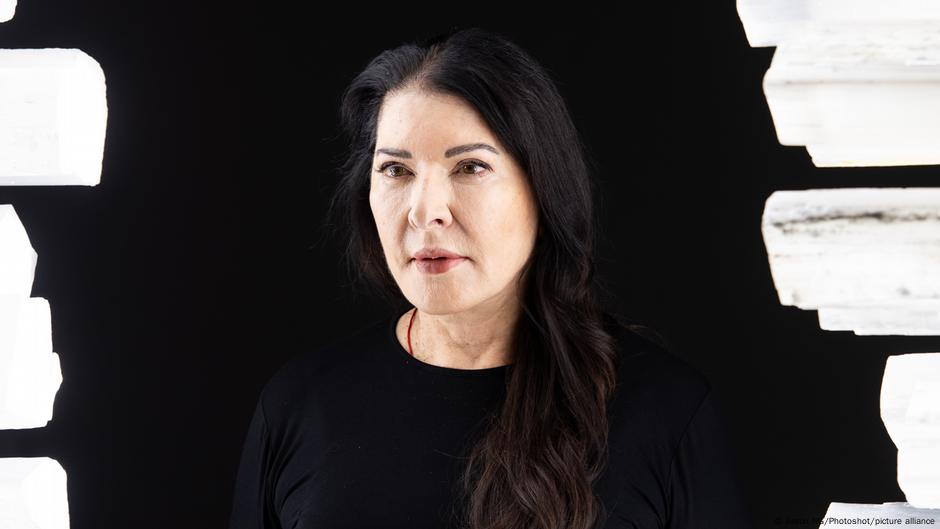

The silence is oppressive. It wraps around your throat like a leaden band, making breathing difficult. In this room, which feels like a vacuum, Marina Abramović sits. She reigns. Her eyes rest on her counterpart—unwavering, demanding. No twitch, no blink. Just this intense presence that seems to penetrate you.
This was the scene in 2010 at the Museum of Modern Art in New York, where thousands queued for hours to share a single moment with her. For her performance “The Artist is Present,” Abramović sat for a total of 716 hours—eight hours a day, without speaking, without moving. She neither drank nor ate. A team of assistants ensured that she took her position on time, that her surroundings remained pristine, and that visitor flows were carefully managed. It was a logistical masterpiece that enabled this extraordinary performance. Yet behind the meticulous organization lay radical simplicity: Abramović merely sat and gazed into the eyes of her counterpart.

Kunstmuseum Zürich
I wonder: what makes these encounters so intense? Why does Abramović hold such a grip on us? Or perhaps more importantly: What is performance art, and what does it mean for our lives?
Her art is a provocation, an invitation to push the limits of what is bearable. As early as the 1970s, she began experimenting with her body. In “Rhythm 0,” she placed 72 objects on a table, including a knife, scissors, and a loaded pistol. She sat motionless while the audience was free to do whatever they wanted. Initial hesitation soon gave way to a darker energy. People cut her clothing, injured her, held the gun to her head. Abramović remained unmoved. “I wanted to see how far people would go if they were given total freedom,” she later reflected. A transgression of boundaries that still resonates today.
Born in Belgrade in 1946, Abramović grew up in a strict environment. Her parents, both antifascist resistance heroes, raised her with iron discipline. This willingness to endure, to resist, runs through her entire body of work. In “Art Must Be Beautiful, Artist Must Be Beautiful” (1975), she brushed her hair for hours until her scalp bled. But it wasn’t about beauty. “It was about the absurdity of expectations,” she later said. The expectation that art should be pleasing or enjoyable is something she continually challenges.
Together with her partner Ulay, Abramović created performances that explored the duality of human existence. Their relationship was both an artistic collaboration and a personal adventure. In “Rest Energy,” Ulay aimed an arrow at her heart. A single misstep could have been fatal. Trust, balance, fragility—central themes that permeate her work. When their relationship ended, they bid farewell in a final joint performance: “The Lovers” (1988). Each started walking from opposite ends of the Great Wall of China, meeting in the middle only to part forever. A separation, staged as an epic gesture.

Kunstmuseum Zürich
Performance art is fleeting. It exists in the moment. Yet Abramović has found a way to immortalize these moments. In 2010, with “The Artist is Present,” she catapulted performance art into the mainstream. Millions watched as she spent hours gazing into the eyes of strangers. A simple act, profoundly moving.
One visitor described how he was overwhelmed by an inexplicable wave of emotions during the performance. “It was as if she saw me—not just my exterior, but what lay beneath.” These moments, this intimate seeing and being seen, make Abramović’s art so extraordinary.
Her art is not for everyone. It is demanding, sometimes painful. But it forces us to reflect on ourselves, on our boundaries, on what defines us. In her recent works, such as “The Abramović Method,” she invites audiences to learn her techniques. It is about mindfulness, presence, and experiencing the moment. Participants sit in absolute silence, focusing on their breath, their bodies. “The method is training for the soul,” she says.

Kunstmuseum Zürich
Like any radical art form, Abramović has her critics. Some accuse her of narcissism, others call her work charlatanism. But for her, art is not about being liked. “Art should hurt,” she says. “It should make you think about your life.”
One recurring criticism is the question of authenticity. Is it still art when millions watch, when sponsors are involved? Abramović remains unfazed. Her art has not changed; it has only become more visible.
With her current retrospective at the Kunsthaus Zürich, Abramović has further cemented her status as one of the most influential artists of our time. The exhibition, running from October 25, 2024, to February 16, 2025, includes works from all phases of her career. It is not just a tribute to her life’s work but also an invitation to experience her art firsthand. Here it becomes evident that performance art is more than an aesthetic experience—it is a journey into the innermost self.
Visitors can engage with interactive installations, view historic performances on video, and even participate in workshops. The exhibition succeeds in making the intensity of her art accessible to a broad audience.

Kunstmuseum Zürich
Abramović has transformed the art world by forcing us to look—at ourselves, at our boundaries, at our potential. Her performances are more than enactments; they are encounters with the essence of what it means to be human. Her art will endure, even if the moments are fleeting. For it leaves traces—in our minds, in our hearts.
And yet, Abramović is not just an artist who plays with extremes. She is a storyteller, a chronicler of the human condition. Her works reflect societal dynamics, individual psyches, and collective desires. Her performances are like a prism, breaking humanity’s light into its myriad colors. Through her, we discover not only who she is but also who we are.
One of her key works illustrating this introspective dimension is “Cleaning the Mirror.” Using a surgical brush, she scrubbed a human skeleton arm—a poetic, almost meditative image addressing life’s transience. “We clean what we will soon become,” Abramović said of the work, which resonates with metaphysical depth and reminds us of humanity’s fragility.
Abramović has the ability to bring us to the edge of what is bearable, only to guide us to a deeper understanding of ourselves. Whether it’s the long silence in a room, the pain of an enduring gaze, or the simple closeness of another human being—she compels us to confront what we often avoid. Performance art, Abramović says, is a bridge between artist and viewer, between life and death, between being and seeming.
It is this power, this magic of the moment, that makes Abramović unique. While traditional artworks like paintings or sculptures create lasting objects, performance art leaves no physical traces. It is ephemeral, but for that very reason, so powerful. Because what remains is not the work itself but the transformation it provokes within us.
The retrospective in Zürich is more than an exhibition. It is an invitation to encounter oneself. Abramović’s works teach us that art is not an escape but a challenge. It is not a distraction but an engagement. And above all, it is not an illusion but a mirror—one that shows us who we truly are.
The exhibition runs until February 16, 2025, showcasing works from all phases of her career, including iconic performances and a new interactive piece.